

On This Page
For most people trying to get out of debt, paying as little as possible during the process is the guiding star. And that is certainly a reasonable way to look at the problem. After all, money is a scarce resource and it makes sense to conserve it. But when paying off debt, time often, as the old saying goes, IS money. Because with time comes interest. And interest means money.
So it's important to keep time in mind when formulating your debt payoff strategy.
With these factors in mind, the "Debt Avalanche" method is one of the most efficient strategies available. This approach targets your highest-interest debt first and moves to eliminate it as quickly as possible. Like trying to take the other team's best player out of the game. With average credit card interest rates exceeding 20%, those balances accrue interest very quickly. The Debt Avalanche method helps you eliminate that cost quickly by directing every possible dollar towards the most expensive debt.
What Is the Debt Avalanche Method?
The Debt Avalanche method is a structured repayment plan that orders your debts by interest rate rather than balance size. You continue to make the required minimum payment on each debt every month to keep things floating. Then you direct all available funds entirely to the debt with the highest APR. Once the balance on that account reaches zero, you roll the entire amount you were paying monthly over to the account with the next highest APR. Repeat until all debts are eliminated. Very simple.
The core concept is that the process compounds over time (hence the "avalanche" metaphor). By eliminating the highest interest debt first, you minimize the total amount of interest you are paying on your debt load, directing more of that money towards principal and accelerating the rate at which you pay off your debt.
A Step-by-Step Guide to Debt Avalanche
Follow these steps to implement the plan:
- List every debt. Create a simple spreadsheet or list with the current balance, interest rate (APR), and minimum monthly payment for each debt. Include credit cards, personal loans, student loans, and any other unsecured debts you want to target. You can decide later whether to include secured debts like a car loan.
- Sort by interest rate. Rank the debts from highest APR to lowest APR. This order becomes your payoff sequence.
- Determine your extra payment amount. Review your budget and calculate how much money you can realistically put toward debt beyond the minimum payments each month. Even an extra $100–$300 makes a meaningful difference.
- Pay minimums on everything. Send at least the minimum due on every account by the due date to protect your credit and avoid fees.
- Apply all extra money to the highest-rate debt. Add your full extra amount to the minimum payment on the top debt on your list.
- Roll payments forward. When the first debt is paid off, add the amount you were paying on it (minimum + extra) to the payment for the next debt on the list. Continue this "roll-down" process.
- Repeat until debt-free. Keep going down the list until every debt reaches zero.
This process is going to require some tracking, but it's very straightforward once you have your list set up. It's good to update balances monthly as you make payments as that will create a strong sense of psychological momentum.
Here is an example profile to model from (common in 2026):
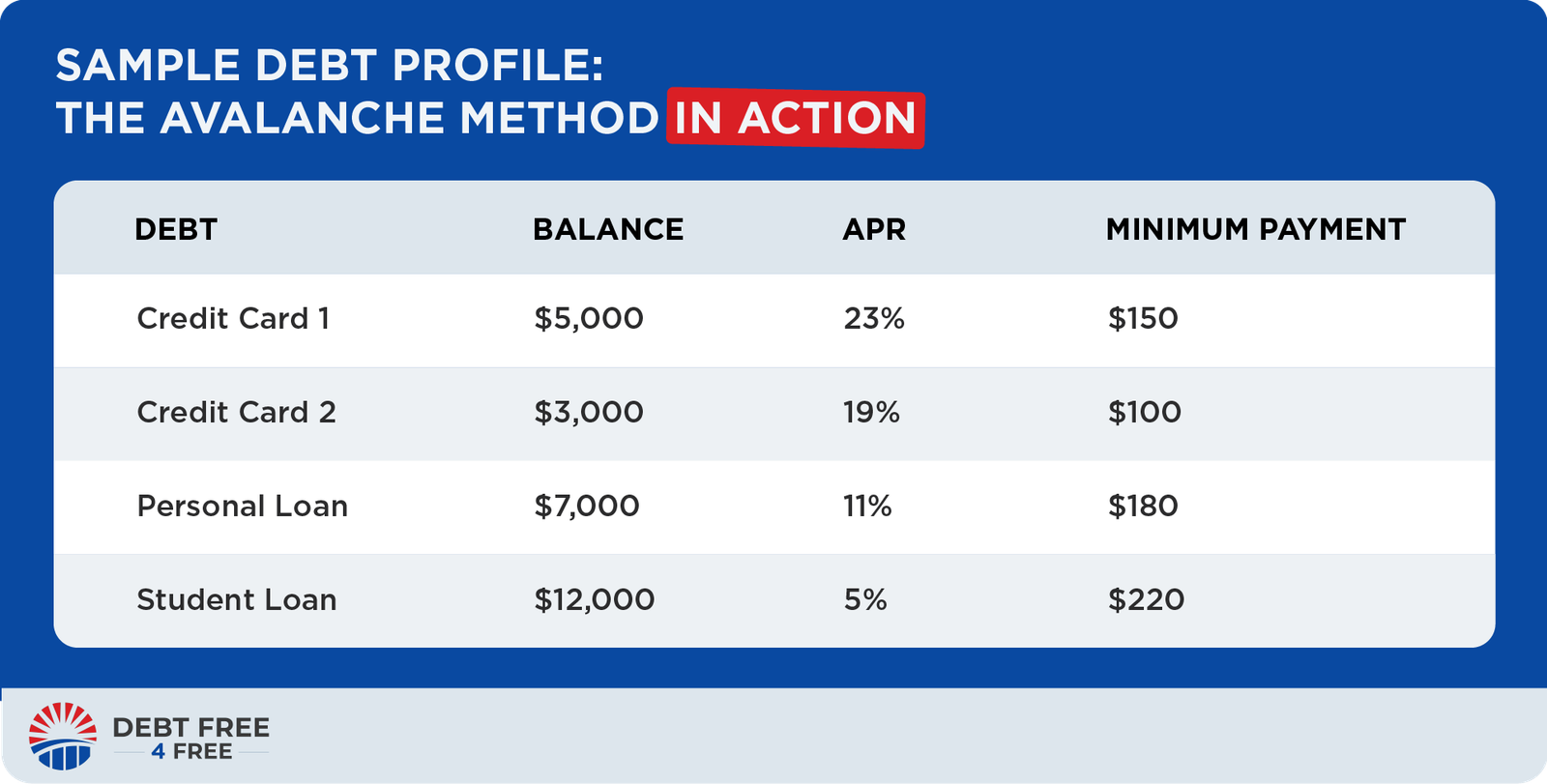
You have gone through your finances and found $400 extra per month you can put towards debt payment. Under this method, you target Credit Card 1 first. Your current monthly minimums are already $650, so this means you'll be putting $1050/mo total to paying down your debt. Adding $400 to your payment on Credit Card 1 means you're now paying $550 there. This cuts down that balance quickly and should pay it off within 12 months.
Fast forward and now Credit Card 1 is paid off. You take the $550 you were paying there and roll it to Credit Card 2. That payment now becomes $650/mo. It will take a little less than 5 months to pay down at this rate. When you zero this one out, you'll roll that $650 over to the Personal Loan. The $180 minimum payment now becomes $830. At that rate, this one will fall in under 9 months. Finally, you'll roll all $830 over to your Student Loan. At $1050 per month, the account that once felt impossible to pay off will vaporize quickly, and should be gone within a year.
All told, this plan will guarantee you are totally out of debt within 38 months. If you can find snowflake payments to add as you go, you can cut this down by several months or perhaps even a year. A problem that once seemed overwhelming can be gone in less than 3 years.
Model your avalanche without the spreadsheet
The free Credzy plan orders your balances by rate, rolls each payment into the next debt automatically, and projects your real debt-free date as you go. No fees and no credit check.
Start My Free Plan →Benefits of the Debt Avalanche Method
- Maximum interest savings. Every extra dollar goes to the debt costing you the most, reducing the total amount paid over time.
- Mathematically optimal. When interest rates vary significantly (common with credit cards versus loans), this method delivers the lowest overall cost.
- Faster long-term progress on expensive debt. High-rate balances stop growing as quickly, which can shorten the overall payoff timeline in many scenarios.
- Clear logic. The order is based on objective numbers rather than feelings, which appeals to analytical personalities.
Potential Drawbacks
The biggest challenge is always psychological. If your highest interest debt also has a large balance, it may take a while to pay off completely. If that is the case, you may benefit from restructuring your debt while going through this process. For resources on how to go about this, go here.
You need a quick win to generate momentum. Eliminating a debt will give that to you, so having a high balance, high interest rate debt can be a real challenge to creating that. Most people are generally aware of their interest rate and avoid this, but a significant number of people carry high balance, high-interest debt. It's good to be aware of this before starting and plan accordingly.
This method requires consistency and discipline over a long period of time. Getting a win on the board is vital to keep you going and avoid backsliding into bad habits.
Debt Avalanche vs. Debt Snowball
To assess whether Debt Avalanche or Debt Snowball is right for you, along with other resources, go here.
Tips for Success with the Debt Avalanche
Here are some quick tips to maximize success with this method:
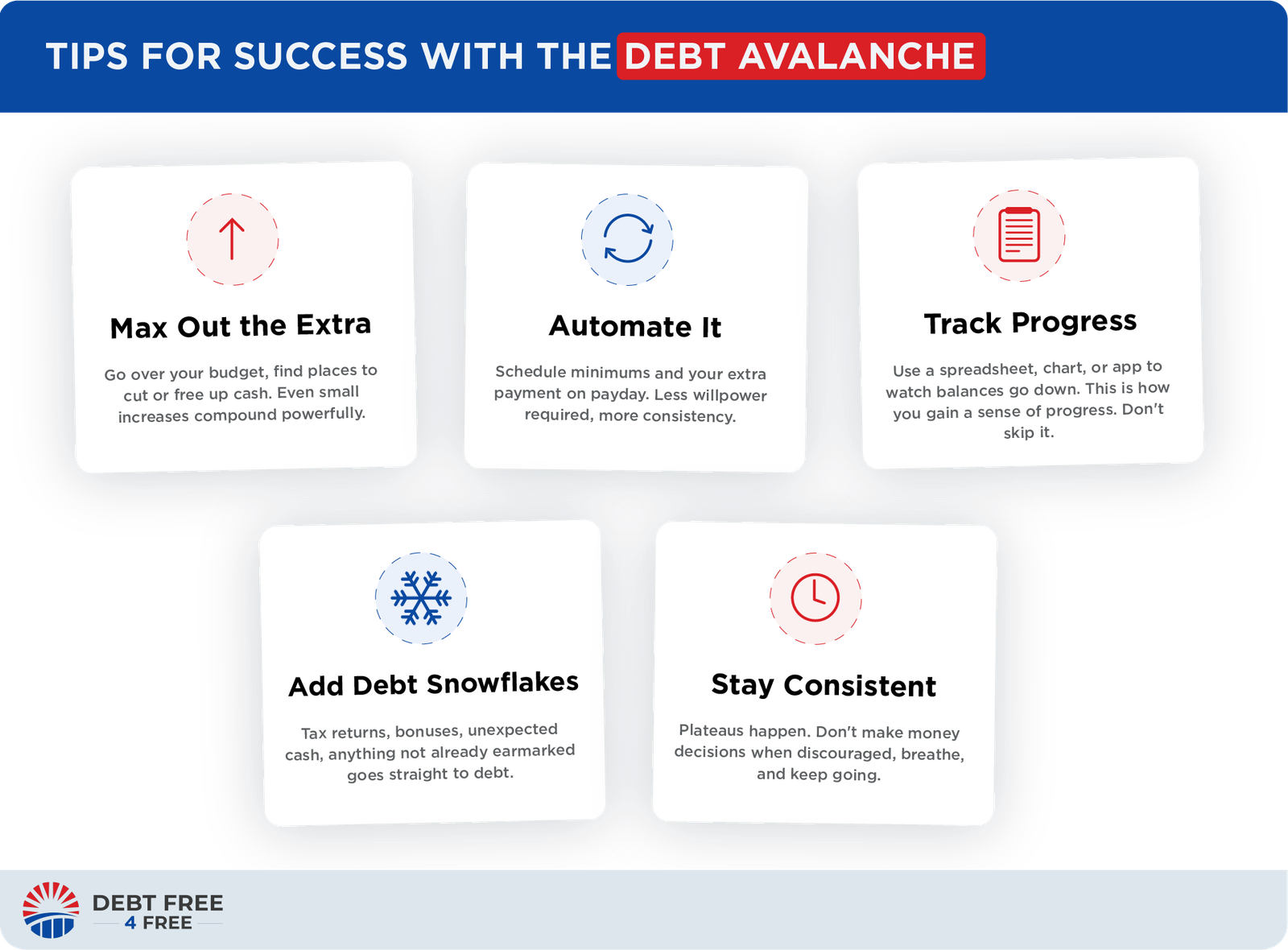
Free or low-cost debt payoff tools and apps can model the avalanche plan, project your debt-free date, and track payments automatically. Tools that support multiple strategies let you compare avalanche results against alternatives.
Is the Debt Avalanche Right for You?
This method works especially well when you have high-interest unsecured debt (credit cards often carry rates of 18–25% or higher) and you value minimizing total cost over rapid psychological wins. If your debts have similar interest rates, the difference between methods shrinks.
If you are already struggling to cover minimum payments, facing collections, or dealing with major life changes, self-directed strategies may need to be combined with or replaced by other options. Review our guide on when to stop trying to pay off debt yourself for honest next steps.
The debt avalanche method gives you a clear, numbers-driven path to becoming debt-free while paying the least possible in interest. It requires patience and consistency, but for many people the financial results make the effort worthwhile.
Start applying the steps today: list your debts, order them by rate, and commit to the extra payment you can realistically afford. Progress builds from there.