
Table of Contents
I feel like I'm going nowhere. I exist to pay bills, service my debts, and work to provide a lifestyle for some rich guy in a wood-paneled office that I will never be able to enjoy myself. I work so hard every day, but I never seem to make any progress. It just feels like I'm running in place.
If this describes you and your struggle to pay off credit cards, student debt, medical bills or personal loans, you are not alone. There are millions of Americans who find themselves in this exact situation. But what's the best solution?
So today we are going to cover different options and which might be best for you. Should you go with a self-directed payoff approach, or would it be better to enroll in a debt relief program that handles negotiations for you? nfcc.org
In order to answer this question, you'll need to understand a few details about your situation: what is your total debt? How quickly do you need relief? How long can you afford to spend resolving your situation? What kind of budget discipline are you capable of? A self directed plan keeps you in full control and avoids paying hard-earned money to a third party. It also prevents credit damage that can take years to correct. But it requires time and consistency to implement, and oftentimes leaves options on the table that could have helped you get where you're trying to go more quickly, or even less expensively. Debt relief programs, on the other hand, can reduce what you owe faster, but come with significant costs, risks, and trade-offs. experian.com
What Is Self-Directed Debt Payoff?
In a self-directed payoff, you take full responsibility for paying off your debts. You use your own strategy, formulate your own plan, go at your own pace with no 3rd parties involved. That means you develop your own budget, prioritize which accounts to pay down first or quickest, and employ proven methods like the debt snowball (smallest balances first to generate momentum and a sense of progress) or debt avalanche (highest interest debt first to maximize principle payments).
Common tools include:
- Zero-based budgeting or the 50/30/20 rule
- Cutting expenses and finding extra income (side hustles, negotiating bills)
- DIY interest rate negotiations with creditors
- Free or low-cost tracking apps
Most people who choose this route have a manageable debt load and extra money in their budget to pay down balances relatively quickly (five years or less). There are many who aren't in position to take this approach, but if you fall into this category, it's a strong route to consider.
What Are Debt Relief Programs?
Debt relief (also called debt settlement or debt resolution) involves negotiating a settlement with your creditor on the debt that you owe. Typically this would be done through a 3rd party who does it on your behalf, but it's important to understand that you can also attempt to negotiate the debt yourself. Usually your debt settlement partner will ask you to stop making payments on the accounts in question and instead save that money in a dedicated account that will be used to begin payments on the settled amount. Once enough money is built up in the account, they will arrange a lump-sum settlement for less than you owe.
This route can be very appealing to customers who are overwhelmed with consumer debt like credit cards or personal loans. Not all debt is ideal or even eligible for these programs, so it's not a total get-out-of-jail free card, but it can make an enormous difference in the right situation. How much you can negotiate the debt down is an important detail, and can vary quite a bit depending on the type of debt, the creditor involved, and other factors. But oftentimes a 50% cut in the total debt is achievable, with some situations yielding an even larger drop.
There are other types of debt relief available besides debt settlement plans. The two most common are known as 1) Debt Management Plans and 2) Debt Consolidation Loans. These can be more beneficial than debt settlement in certain situations, and usually aren't as corrosive to your credit profile. These are address in more detail here.
Main types of debt relief:
- Debt Settlement: Reduce principal (most common “debt relief” option)
- Debt Management Plans (DMPs): Nonprofit credit counseling with lowered interest rates (you still pay full principal)
- Debt Consolidation Loans: Combine debts into one payment (if you qualify)
Each of these programs usually target unsecured debt like credit cards, personal loans, or medical bills. They usually take 2–4 years to complete and come with a fee paid to the 3rd party in exchange for their services. experian.com
Side-by-Side Comparison: Key Factors
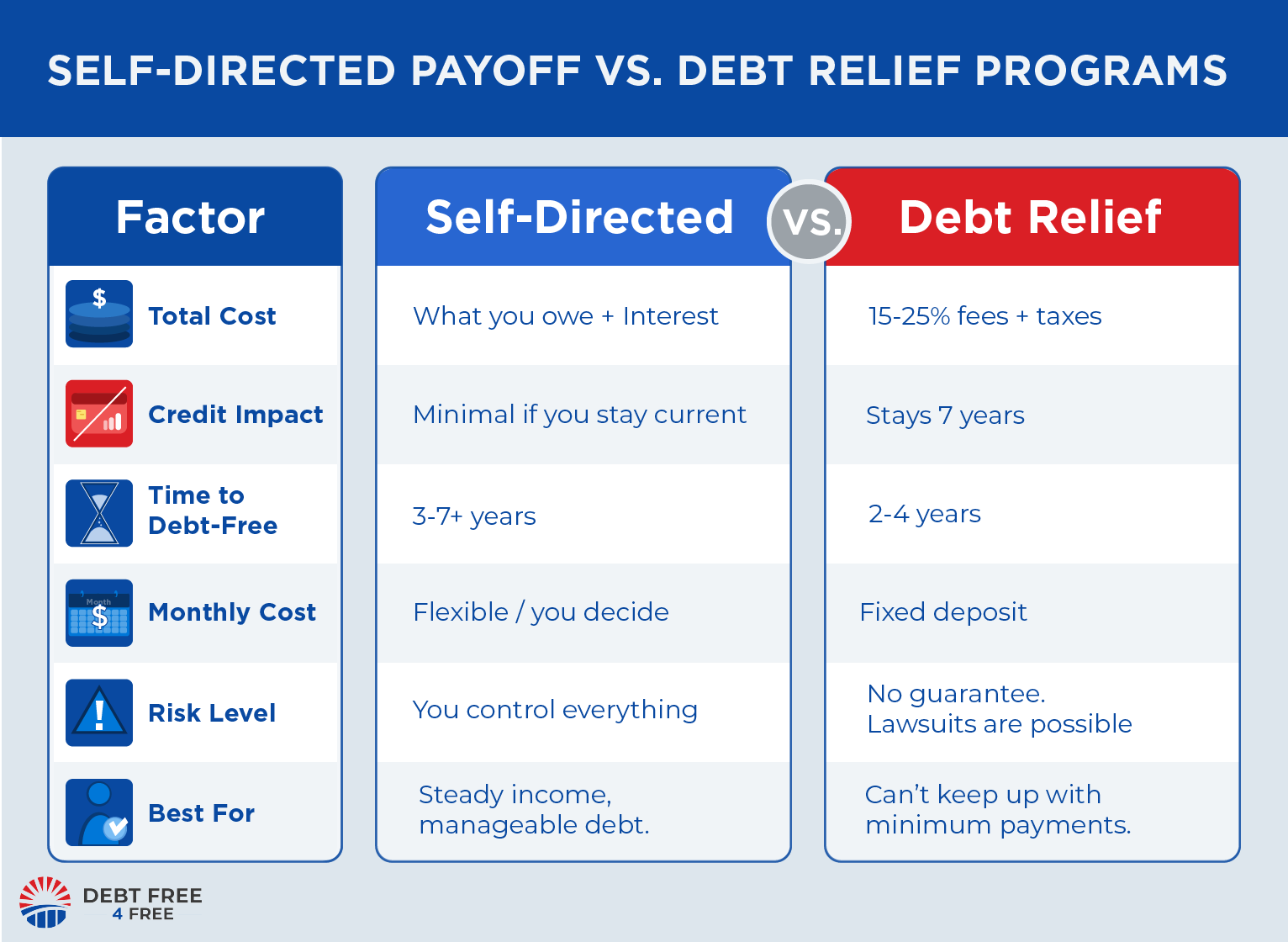
Debt settlement fees typically range 15–25% of enrolled debt. Forgiven amounts may be taxable income. Settled accounts remain on credit reports for up to 7 years from the original delinquency date. These can be combated using services like creditinnovationgroup.com once the debt is discharged and the settlement is agreed. experian.com
Pros and Cons of Self-Directed Payoff
Pros:
- No extra fees — You pay only what you actually owe.
- Full control and flexibility.
- Builds strong financial habits and confidence.
- Minimal credit damage if you keep making at least minimum payments.
- Works well alongside free tools (budget apps, credit monitoring).
Cons:
- Can feel slow if debt is very large or interest rates are high.
- Requires strong discipline and budgeting skills.
- No professional negotiation leverage.
Many people successfully get out of debt using the debt snowball or debt avalanche method. For a detailed breakdown on how these work and which one to use, go here.
Pros and Cons of Debt Relief Programs
Pros:
- Potential to reduce principal (sometimes 30–50% savings before fees).
- Professional negotiators handle calls and paperwork.
- Structured plan can reduce stress for those in hardship.
- Faster resolution in severe cases.
Cons:
- Fees eat into savings (net savings often closer to 20% after costs).
- Credit score damage is almost guaranteed during the process.
- Creditors may sue or continue collections while you're not paying.
- No guarantee every debt will settle.
- Forgiven debt often creates a tax bill. creditinnovationgroup.com
When to Choose Self-Directed Payoff
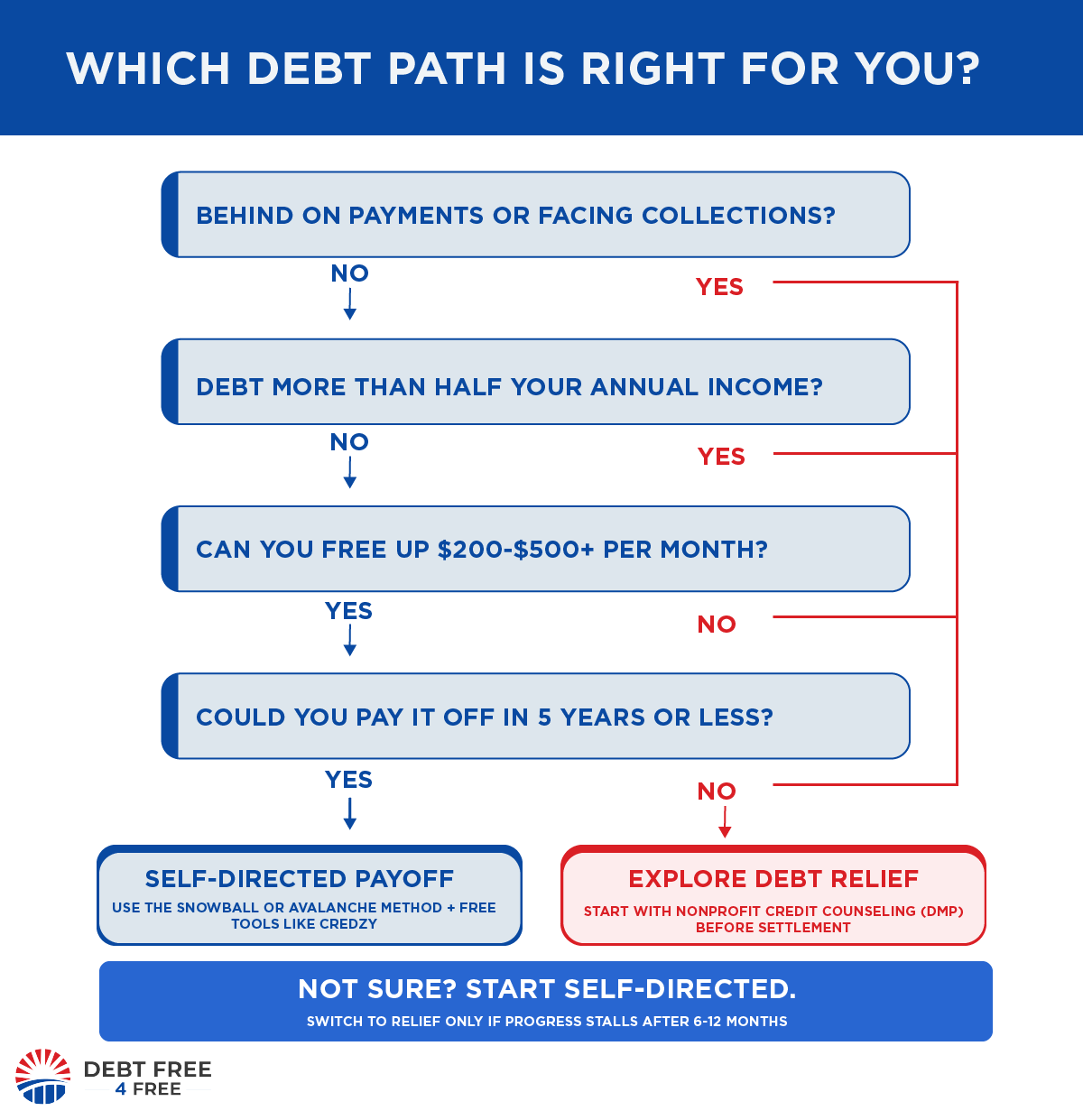
Consider handling it yourself if:
- Your total unsecured debt is less than half your annual income.
- You can realistically pay it off in 5 years or less with extra payments.
- You have (or can create) $200–500+ monthly surplus after essentials.
- Your credit is still decent and you want to protect it.
- You're motivated and organized.
Someone with $15,000 in credit card debt at 22% interest who finds $400 extra per month could be debt-free in about 4–5 years using the avalanche method, saving thousands in interest.
When to Consider Debt Relief Programs
Debt relief makes more sense if:
- You're already behind on payments and facing collections.
- Minimum payments feel impossible and debt is growing.
- You have $20,000+ in unsecured debt with no realistic payoff timeline.
- Hardship (job loss, medical issues, divorce) makes self-payoff unworkable.
Even then, explore nonprofit credit counseling (DMPs) first—they have lower fees and less credit impact than settlement. navyfederal.org
Hybrid Approach: The Smart Middle Ground
You don't always have to choose one extreme. Many people:
- Start with self-directed strategies (budgeting + extra payments).
- Use free tools to track progress and build credit simultaneously.
- Switch to relief only if self-directed stalls after 6–12 months.
This is where the Credzy platform shines. The app provides free debt tracking with both snowball and avalanche options by default, plus credit disputing and monitoring, all without upfront costs. The only fee is to purchase credits, which can be redeemed to pull your credit and assess your credit profile.
In Summary: Understand your Options
Self Directed Payoff is often the best option because it teaches important lessons. For many people, consumer credit is a dangerous temptation that is hard to resist. The process of paying down a large debt yourself can instill the financial discipline needed to ensure that you do not find yourself back in the same situation down the road. It can also provide the impetus to develop your understanding of money management, and how the financial system works. These are vital skills to succeeding in the modern economy.
Here are the best actions steps to take today:
- List all debts, interest rates, and minimum payments.
- Build a realistic budget and calculate payoff timelines.
- Try negotiating lower rates directly with creditors.
- Track everything in one place and monitor your credit.
Download the Credzy app and start your free plan today.
Once you've logged in and setup your profile, there are debt management tools available for free in the app, and self directed credit disputing as well.
Start My Free Plan →Debt Free for Free is a matching service, not a debt relief provider or financial advisor. Consult a licensed professional or nonprofit credit counselor for personalized advice. Information current as of 2026.