

Table of Contents
The debt snowball method is a popular debt payoff strategy where you list your debts in order of smallest balance to largest, pay off the smallest debt completely, then roll that payment into paying your next smallest debt. In this strategy, it's not interest rates that decide the order, but the balances. It sounds simple. And that's exactly what it is.
The hardest part of getting out of debt usually isn't the math. It's the feeling that nothing you do changes your situation. If you are carrying balances on several cards, a medical bill, and several loans, it can feel like you send money every month and the totals barely budge. The debt snowball method is designed to solve this exact problem. The debt snowball is centered around paying off balances to get a real win as early as possible. Those wins are what keep you going, and the success of paying off a debt completely leaves you more confident that you can succeed again.
In this guide, we walk through exactly what this method is, the research behind it, how to execute the strategy yourself, and a comprehensive look at who this method is most suited for. If you want to learn about other methods or understand the wider picture of how to pay off debt, check out our pillar guide on how to pay off debt on your own covers every method side by side.
What the debt snowball method is
Popularized by personal finance author Dave Ramsey, the debt snowball method is rooted in much older ideas around human behavior. What the method is, at its essence, is a way of ordering your debt payoff. You continue making the minimum monthly payment on every debt so that nothing goes delinquent. Then you take whatever extra money you can find each month and direct all of it at the single debt with the smallest balance.
The important piece of this is that, when the smallest debt is completely paid off, you do not pocket the freed up money. Instead, you take the full freed up payment and add that amount to paying off your next smallest balance debt. This makes so that the second debt is now getting paid off much faster with the rolled over money from the previous debt. When the next debt is fully paid off, you roll the payment of the first and second debt to pay off the third debt and so on. Each payoff makes so that the next debt is paid off quicker. This is where the snowball description comes from as you can imagine this strategy as a small snowball rolling downhill consistently growing larger and rolling faster.
Pay off the smallest balance first as well as the minimums on everything else. Then, every payment you free up gets rolled into the paying off the next debt.
This method is a direct contrast to the debt avalanche method, where debts are ordered by interest rate instead of by balance. The avalanche method is mathematically cheaper because it focuses on the debts where you're paying the most in interest. Despite the snowball costing slightly more in total interest, it produces a fully paid off account sooner, which gives you early success to build off of. We go in depth on how these two methods compare in our separate guide on snowball versus avalanche, and the short answer is that the best method for you is the one you will actually stick with.
Why it works (the research)
For many years, the debt snowball was dismissed as a financially inferior option. That was until researchers began looking at people's true behavior rather than what a spreadsheet says about people's behavior, and this completely changed the way the debt snowball method is viewed.
The most cited study on the topic comes from David Gal and Blakeley McShane at Northwestern University's Kellogg School of Management. In their 2012 paper, "Can Small Victories Help Win the War? Evidence from Consumer Debt Management," published in the Journal of Marketing Research, they analyzed data from a debt settlement firm and found that the number of accounts a person closed was a strong predictor of whether they would entirely eliminate all of their debt. This was true regardless of the dollar balance of these accounts which can only mean that closing accounts through paying off an entire debt matters much more than how large of an account is paid off.
Completing a debt, not shrinking a balance, is what seems to keep people in the fight long enough to win it.
A separate analysis published in the Harvard Business Review, which reviewed thousands of participants in debt programs, reached a similar conclusion. They too found that people who concentrated their efforts into paying off one account at a time were more likely to get out of debt overall. This lines up with a psychological phenomenon known as the progress principle which is the well-documented idea that visible progress towards a goal is one of the strongest forces of motivation and persistence.
The snowball method prioritizes momentum in place of mitigating interest. For anyone who has stalled out on becoming debt free in the past, retaining momentum is a worth it trade.
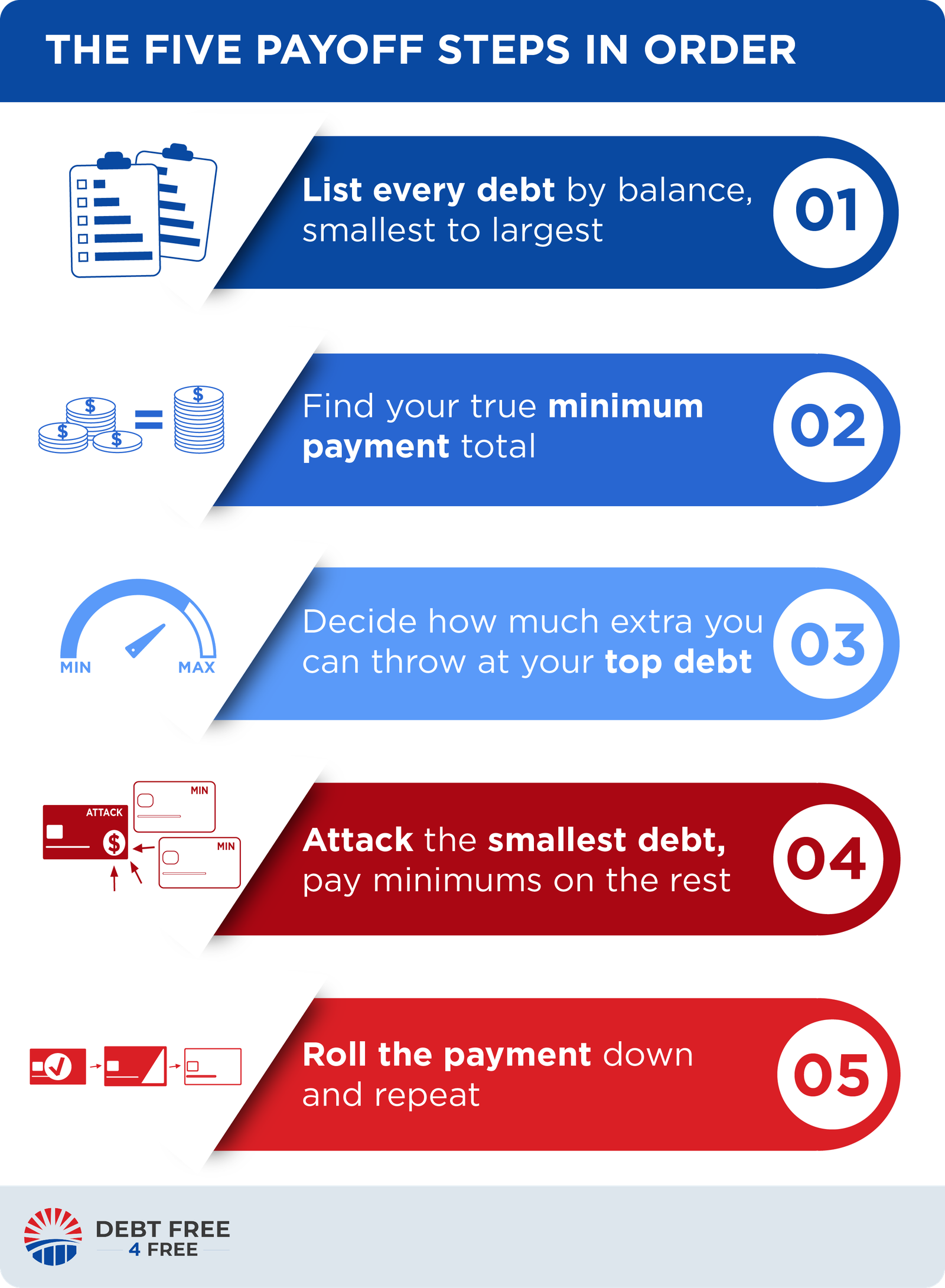
The 5 steps, in order
It typically takes only half an hour to set up your debt snowball, a setup you only have to do once. After the initial configuration, the strategy runs on autopilot until you are debt-free, as long as you stick to the plan.
Step 1: List every debt by balance, smallest to largest
Begin by writing down each debt you owe. Be sure to include everything, from credit cards to buy-now-pay-later balances, each debt must be accounted for. For each one, take note of the total balance, the minimum payment, as well as the interest rate. Then, sort the list from lowest to highest balance, with the smallest balance debt at the top of your list.
Step 2: Find your true minimum payment total
Next, add up the minimum payment of all of your debts. This number will act as the floor that you have to reach each month no matter what, so that you don't slip into late statuses and damage your credit. This is your non-negotiable minimum, the snowball will work on top of these payments.
Step 3: Decide how much extra you can throw at the top debt
Now, look at your budget and assess how much you can contribute on top of your minimums each month. Even fifty dollars matters, each dollar you add to paying off your debt moves your debt-free date closer. If you want a structured way to calculate a budget-friendly amount to contribute, a zero-based budget is the tool most snowball users rely on.
Step 4: Attack the smallest debt, pay minimums on the rest
Then, every month, pay the minimum payment on each of your debts. On the debt at the top of your list, pay all of the extra money you can on top of your minimum payment. Repeat this process each month until your top debt hits zero. Then you can celebrate, because finishing a pay-off makes your next pay-off even more likely!
Step 5: Roll the payment down and repeat
Finally, once you've paid off your first debt, take the entire amount you were paying, both the minimum and the extra, and add it to the payment of your next smallest balance. Keep doing this roll over each time you pay off another debt and watch as the payment aimed at each new debt becomes larger and larger. Keep it up and the last few debts will often disappear faster than you would have ever expected.
A worked example
Numbers make this concrete. Say you have four debts and you can put $650 a month toward debt total. Here is the starting picture, sorted smallest balance first.
| Debt | Balance | APR | Minimum |
|---|---|---|---|
| Store card | $600 | 26% | $25 |
| Credit card A | $2,300 | 24% | $58 |
| Credit card B | $4,800 | 21% | $120 |
| Personal loan | $8,000 | 13% | $220 |
Your minimum payments add up to $423. You have $650 to work with, which leaves $227 in extra firepower each month. Here is how the snowball runs.
- Target 1, the store card ($600). You pay its $25 minimum plus your $227 extra, so $252 a month. It is gone in roughly three months. That is your first win, and it arrives fast.
- Target 2, credit card A ($2,300). You now have $252 freed up from the store card. Add it to card A's $58 minimum and you are paying about $310 a month. Card A clears in roughly eight more months.
- Target 3, credit card B ($4,800). Roll the $310 into card B's $120 minimum and you are now attacking with about $430 a month. The snowball is getting heavy.
- Target 4, the personal loan ($8,000). By the time you reach it, you are rolling roughly $650 a month onto a single debt. Even though it is the largest balance, it falls quickly because the entire snowball is now aimed at it.
Notice the pattern. Your monthly debt payment never goes up. It stays at $650 the whole time. What changes is how much of that $650 lands on a single target, which climbs from $252 to the full $650 as accounts close. That accelerating focus is the snowball effect in action.
In this example the store card and card A carry the highest interest rates anyway, so the snowball and the avalanche would start in nearly the same place. That overlap is common. The two methods often disagree far less than people assume.
Run your snowball without the spreadsheet
The free Credzy plan includes a debt tracker that orders your balances, rolls each payment into the next debt automatically, and shows your real payoff date as you go. Start your free Credzy plan and set up your snowball in a few minutes.
See My Free Plan →Mistakes that stall a snowball
The debt snowball method is simple, but a few predictable errors can slow you down and cause you to lose your momentum. Watch out for these mistakes.
Skipping minimums on the other debts
The extra money you budget for your snowball goes to the top debt alone. Every other debt still needs its minimum payment. If you miss one, you can trigger a late fee as well as a hit to your credit. Automate your minimums so this never happens and your progress isn't lost.
Adding new debt while you pay off old debt
A snowball cannot work if you keep adding fresh snow at the top of the hill. The single most important behavioral change is to stop using the cards you are paying down. Switching to a debit card or cash for everyday spending during your payoff period is what separates the people who finish from the people who tread water for years.
Setting the extra payment so high you burn out
Ambition is good, but if you commit every spare dollar and leave nothing for a small emergency, the first surprise expense puts you right back on a credit card. Keep a modest starter emergency fund, often around $1,000, before you go all in, so a flat tire does not undo three months of progress.
Forgetting to roll the payment down
When a debt is paid off, it is tempting to absorb that freed-up money back into everyday spending. That quietly kills the snowball. The whole engine depends on rolling the full payment into the next debt. Redirect it the same day the account closes, before it disappears into your budget.
The bottom line
The debt snowball method works because it is built around how people actually behave, not how a calculator wishes they would. You list your debts smallest to largest, pay minimums on everything, and pour every extra dollar into the top of the list until each debt falls and its payment rolls into the next. The research from Northwestern and others is consistent: finishing accounts keeps people going, and people who keep going are the ones who get out of debt.
It is not the only method, and it is not always the cheapest. But if you have ever started a payoff plan and quietly given up, the snowball is probably the one worth trying, because it is designed to hand you a win before you have a chance to quit. Decide on your order this week, automate your minimums, and aim everything you can spare at that first small balance. The first time an account hits zero, you will understand why this method has lasted.