

On This Page
Carrying debt feels overwhelming. U.S. Household debt was approaching 19 trillion (!) as we crossed into 2026 and credit card balances alone stand at $1.25 trillion. Student loans, after the reprieve granted during the Biden administration, sit at $1.7 trillion. Americans are buried in debt. So, if you're feeling like your debt load is insurmountable, and that everyone else around you is getting ahead while you are struggling to pay minimum payments, chances are that is very much not the case. More and more people are living large on credit, and then carrying that around with them everywhere they go.
Many of those people ask us if it's possible to escape that debt without using expensive programs or ruining their credit. The honest truth: yes, it's possible. Thousands of people succeed in digging their way out every year using what we call the "self-directed payoff plan." This requires discipline as well as planning and consistency. But the benefit is that you are always in control, you avoid extra fees, and you build skills and understanding that lasts a lifetime.
Step 1: Understand Your Current Debt
Make an exhaustive and thorough list. Make sure you account for every:
- Creditor or lender
- Current balance
- Interest rate (APR)
- Minimum monthly payment
- Due date
Download the Credzy app here and pull a credit report. Common debts include credit cards (average APR ~21-23% in 2026), student loans, medical bills, and personal loans. Calculate your total minimum payments. Subtract that from your monthly take home pay after you pay for all essential items (food, rent, utilities). It's important here to not count anything as "essential" that is not actually essential. The remainder is what you can throw at debt. This number is the weapon you're going to use to attack your debt and relieve yourself of the anxiety and hopelessness it's causing, so you want to maximize it to the greatest degree possible.
Use a simple spreadsheet or the Capacity dashboard inside the Credzy app. Knowing the numbers removes fear, creates clarity, and establishes a starting point that will help you generate a sense of momentum towards your goal. Once you start feeling that, keeping it going becomes much easier!
Step 2: Choose Your Core Repayment Strategy
There are three primary strategies for self-directed debt payment. These three are all time tested and proven ways to cut down your debt load fast. The one you choose depends on your priorities and how much cash you can free up to attack your debt.
Strategy 1: The Debt Snowball Method
The Debt Snowball approach says to pay your minimum payment on everything and then direct all extra money to the smallest balance first. Once that account is paid off, use the funds you were paying toward that account and "roll them up" into the payment you are making on the next smallest account. Rinse and repeat.
This approach is great because it builds wins fast. Once you get that first account paid off, you'll begin to feel the weight lift substantially and your progress towards becoming Debt Free accelerate. This is particularly well suited if you need that psychological boost to keep yourself motivated. It's a winner.
Strategy 2: The Debt Avalanche Method
The Debt Avalanche method says to, again, pay the minimum payment on everything and then direct your extra money towards the highest interest accounts first. This saves more money on interest, which is the silent killer, but doesn't give you that sense of quick payoff created by the Snowball approach.
When using this approach, keep an eye on your monthly interest charge. As you pay the balance down, your interest payment will decline proportionately. The money you save on interest every month will compound. Each dollar saved in interest becomes a dollar used to pay down your balance. And that feels great.
Strategy 3: The Debt Snowflake Method
This might be cheating a little to call this a separate approach, but bear with us here: the Debt Snowflake method layers over either the Snowball or Avalanche approach. When using this approach you'll make micropayments on the debt whenever you get free cash. Win $50 from a friendly wager? Pay down the debt. Save $100 on a major purchase unexpectedly? Redirect it to reduce your principal balance instead of treating yourself. Find $20 in an old pair of jeans? You guessed it: pay down your debt. This method can really help you accelerate the process if you become obsessive about finding extra money to pay that debt down rather than simply relying on your monthly payments to do all the work.
At the end of it all, consistency beats perfection. With $20,000 in credit card debt at 22% APR, paying $400 extra per month could clear the debt in roughly 4-5 years while saving you thousands in interest payments along the way.
Step 3: Build a Budget That Supports Debt Payoff
Lots of people dread the "B" word. But if you want to conquer your debt and eliminate the issue from your life forever, developing a budget is non-negotiable. When you don't have one, your money wanders off in ways you don't realize. It disappears when you aren't looking. It leaks out of holes you didn't know were there. Then, before you know it, you are having to put groceries on credit in order to get to payday.
Here's a good framework for 2026:
- Assign every dollar a job until income minus expenses equals zero. This will help you identify where money is being wasted quickly.
- 50/30/20 Rule: 50% needs, 30% debt payments, 20% wants/savings. Shift aggressively to debt when possible. This will help maintain your willpower while you adjust your habits.
- Cash Envelope System: Use cash for each budget category: groceries, gas, entertainment etc to prevent overspending. When the money is gone, it's gone.
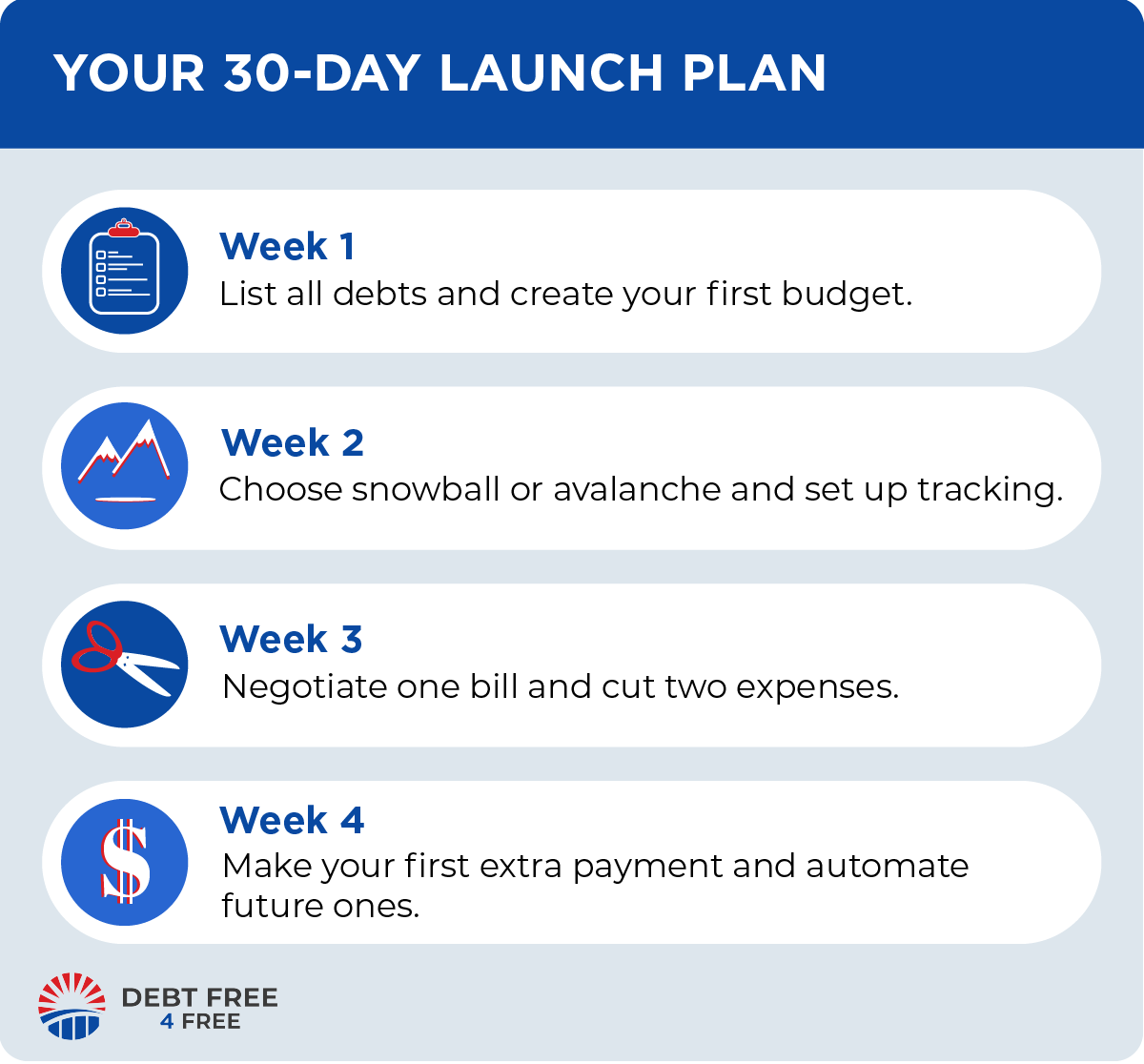
30-day starter process:
- Track every expense for one month.
- Cut non-essentials: subscriptions, dining out, unused memberships.
- Automate minimum payments and one extra debt payment on payday.
Review your budget monthly and adjust as income or expenses change.
Step 4: Find and Create Extra Money
When you're paying down debt, even a small amount extra every month can dramatically shorten your timeline. Look for ways to create an extra $100-$200 more per month by coming up with creative solutions:
- Renegotiate bills: call creditors and ask for lower interest rates. Write a simple script out beforehand so you don't get flustered. Something like "I've been a good customer for X amount of time, can you reduce my interest to match competitor offers?"
- Side hustles can generate extra money. What talents do you have that can help you earn little extra cash? Are you good with your hands? Look for people who need handy-man things done around their house in your free time. Delivery apps, Uber driving, pet sitting, or selling unused items can all help create that extra cash to speed up the process.
- Windfalls. When you get a big chunk of cash, apply ALL of it to your debt. Tax refunds. Bonuses at work. Raises. Put it all to debt. No exceptions.
Small consistent actions compound. One small win, such as a drop in interest on a loan or eliminating an unnecessary bill or two (canceling streaming subscriptions you don't use?) can save thousands over the course of the process.
Step 5: Track Progress with Free or Low-Cost Tools
The world is full of cool new tools these days. New mobile apps with amazing features are always hitting the market. This is where the Credzy tool comes in handy. It will help you stay organized and motivated. Some features included:
- Cash Flow Accelerator with built-in snowball/avalanche calculators
- Debt free date that changes dynamically as you pay down your debt
- Content focused on financial literacy and education
- Credit monitoring powered by your most recent credit data, populated through the app
Log your progress on a monthly basis and then celebrate milestones: paying off your first account, getting under 20k, 15k etc., passing the halfway mark. All of these are great ways to reward yourself with something small. No big splurges, but maybe a night out at a lower end restaurant or a trip to your favorite ice cream spot. This will help you maintain momentum and replenish your will power stores so you can finish strong.
Step 6: Master the Mindset
Self-directed payoff is as much a psychological game as anything. You'll constantly be doing the mental math and engaging with the problem in your downtime.
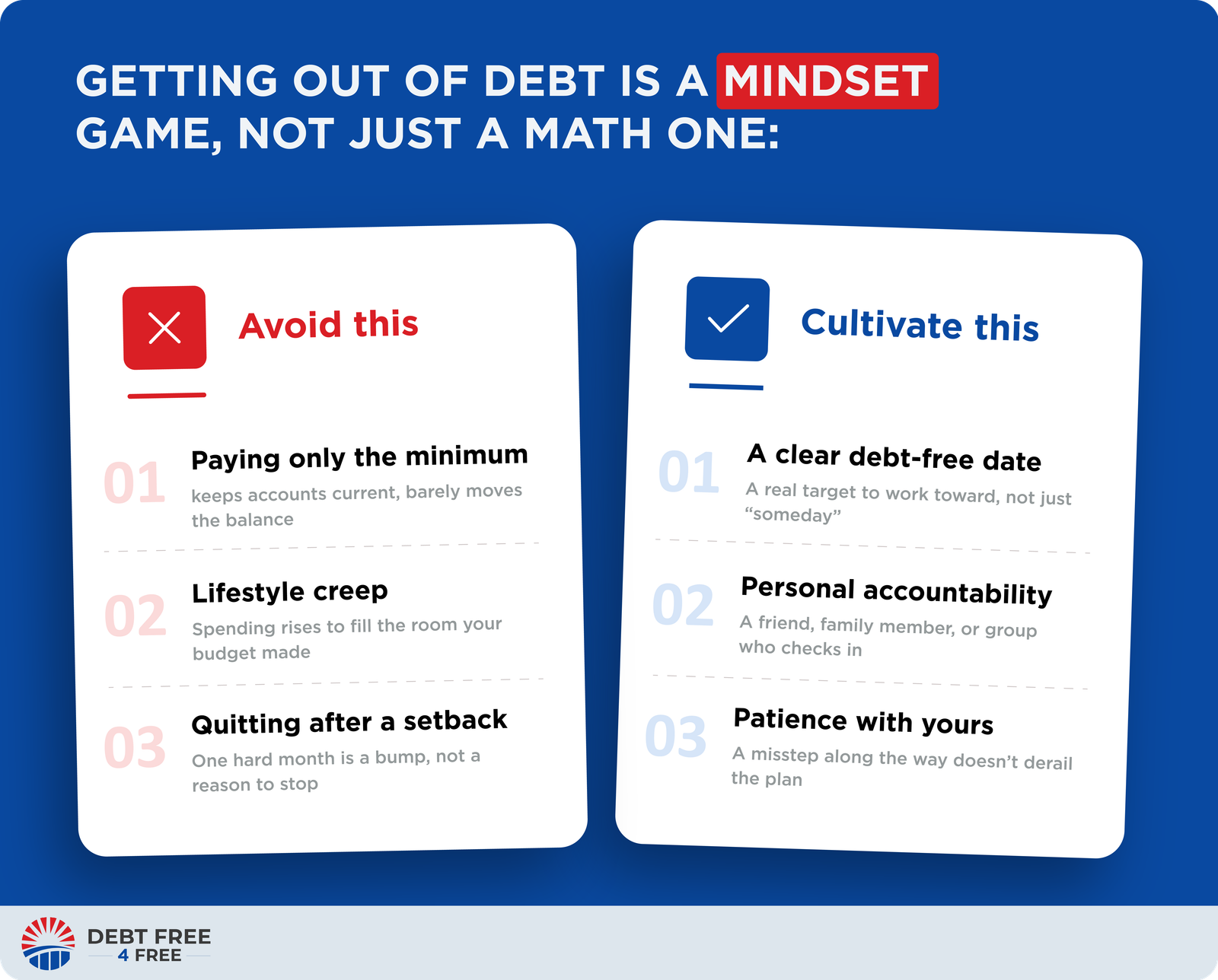
Psychology research shows that small wins and clear progress tracking are the ways to maintain your will power and keep the momentum going throughout the whole process.
Step 7: Know When Self-Directed Payoff May Not Be Enough
Finally, knowing when to use a self-directed approach and when not to is perhaps the most important factor. You may get into your plan and realize that it's too big for you and something more or different is needed.
Remember, Self-Directed works best when:
- Total unsecured debt is less than half your annual income
- The time to pay it off is less than five years
- You already have a steady income base and a surplus in your budget
When you should consider looking for more help:
- Your debt keeps growing despite every attempt to prevent it.
- You keep missing or do not have the money to pay your minimum payments
- You have lost your job/income and payment is impossible
- Overwhelming levels of debt that can't be paid off in a reasonable amount of time
In those cases, explore nonprofit credit counseling, consolidation, or relief options without shame. Many people start self-directed and pivot successfully.
Final Thoughts
Paying off debt is not easy. But it IS deeply empowering. Interest is a silent killer. If you are carrying a heavy debt burden, most of your monthly payments are going to pay interest on your debt. That's hundreds or even thousands of dollars per month that should be going to build the life you want, that is instead going to pay for some rich banker's second home. Escaping this doom loop is absolutely crucial to getting what you hope to get out of life. As you begin making progress, you'll generate a sense of momentum. That momentum is an incredible force. Whatever you do, don't let anything break it. It will carry you to the finish line. Start your free Credzy plan today and get the debt management tool and credit disputing specialists working for you.
This article is for educational purposes only. Debt Free 4 Free is a matching service, not a financial advisor. Data current as of mid-2026.