

This post covers
A debt payoff plan is simply a written commitment about which debts you pay, in what order, and how much you pay each month. That's it. Your payoff plan doesn't need to be a complex budget or an automated spreadsheet, it is something you can quickly build yourself. Follow this guide, and you'll come out the other end with a real plan that is designed for your situation.
Most people don't fail at paying off debt because the math is too hard. They fail because they never actually organized and wrote everything down on paper, and without structure, every month is just a guessing game. A written plan solves this. It tells you exactly what you need to do on payday and it turns the piling stress of debt management into a short checklist. If you want the wider context first, our comprehensive guide on how to pay off debt on your own covers all of the standard debt payoff methods you can apply.
The advantage of a written plan
There is real, significant evidence behind the power of writing things down. The Consumer Financial Protection Bureau has found, through its extensive research on financial success, that most people who set a specific and concrete goal and track it are more likely to accomplish said goal than people who keep the goal only in their head. Getting a real, organized plan put together protects you from the most common point of failure, which is treating one rough month or one mistake as a reason to abandon a plan entirely. When the plan is written down, a hard month is just a smaller payment and not a reason to give up or switch strategies.
A debt payoff plan isn't about creating more willpower out of thin air. It is about making a set of decisions now so that you don't have to make them again under pressure every payday.
What you need before you start
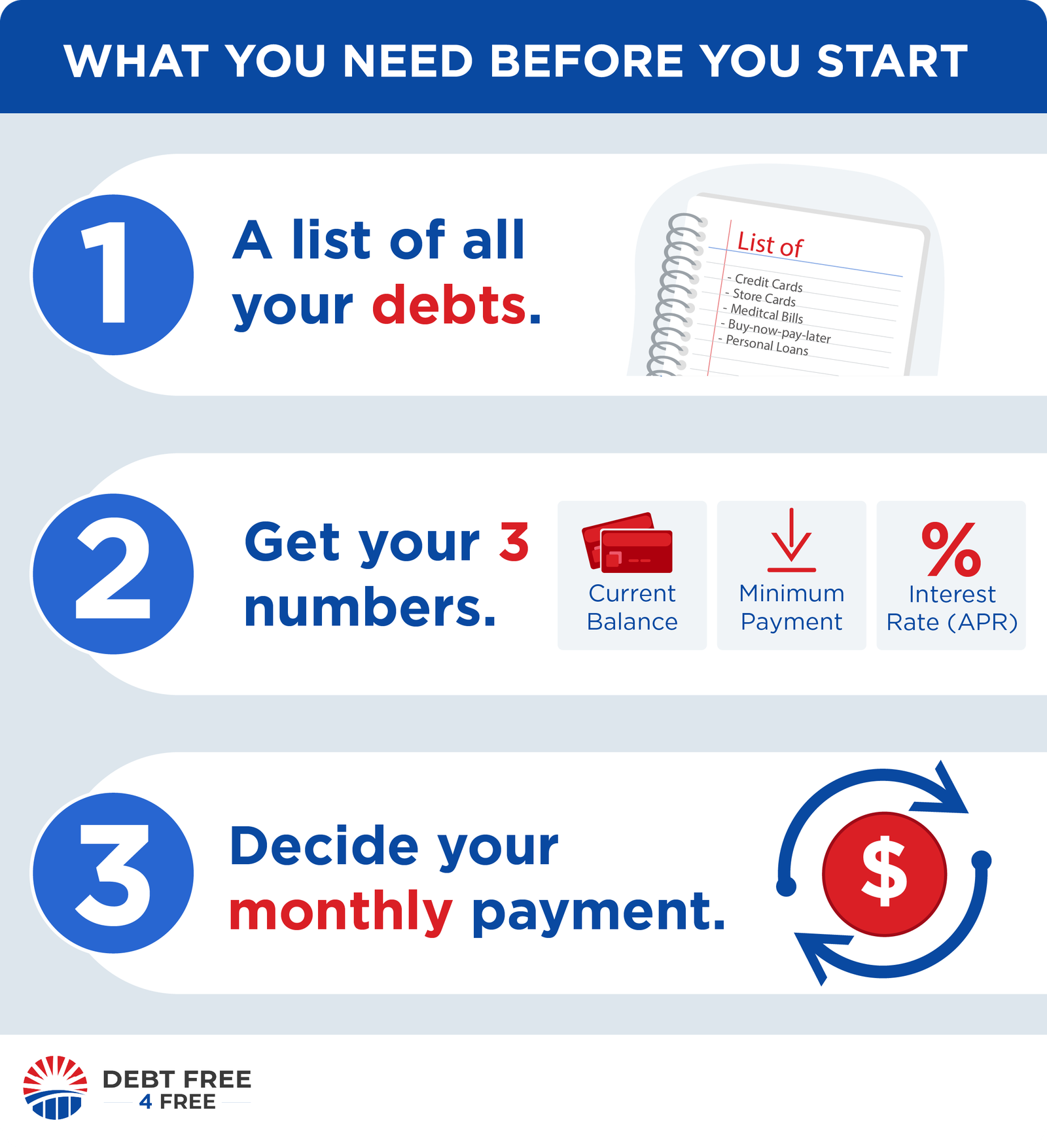
You only need three things before you can begin. None of them should take long to find.
- A list of all of your debts. Credit cards, store cards, medical bills, buy-now-pay-later bills, personal loans, be sure to capture everything you owe. Your most recent statements or a free report from annualcreditreport.com should show you everything you need.
- Get these three numbers for each debt: the current balance, the minimum payment, and the interest rate (APR).
- Finally, you need to decide how much money you can put toward debt payoff each month, in addition to your minimums, while making sure you can still afford your essentials.
This third number is the most important as it is the fuel for your entire payoff plan. Even fifty dollars extra a month brings your debt free date closer. If you aren't sure how much you can safely set aside, you can start low. You can always revise this number later if you find you set it too low, or if more money is freed up.
The 30-minute plan, step by step
Here is a five step breakdown of the whole process. The times are recommendations and estimates, if you need more or less time on a certain step, that is completely fine.
Step 1: List every debt and its three numbers (5 minutes)
Begin by getting everything organized. Write each of your debts down and list their balance, minimum payment, and APR. The goal here is just to take inventory of your starting place. Make sure you catch every debt and double check that your numbers are correct.
Step 2: Total your minimum payments (2 minutes)
Now, add up the minimum payments across all of your debts. This total is the floor that you have to hit every month so that you avoid late payments and any damage to your credit. This number is your non-negotiable minimum that you will build the plan on top of.
Step 3: Decide how much extra you can pay (10 minutes)
This is the step that actually determines how fast you get out of debt, so give it the most time. Look at your take-home income, subtract your essentials and your minimum payments, and decide how much of what is left you can commit to debt each month. It is important to be realistic here because a payment you can sustain for years will always win out against a more aggressive payment that stretches you too thin. Check out the Credzy App's free plan to set up your Capacity tracking and see how much extra room you have to accelerate your payoff timeline.
Step 4: Choose your payoff order (5 minutes)
Now that you have determined your extra payment amount, you now must decide which debt you will pay off first. Two of the most popular, proven methods give you a great place to start. The debt snowball works by focusing on balances. It starts with you paying off the smallest balance and working your way up to the highest. This structure gives you an early win and helps you build momentum. The debt avalanche, another popular method, zeroes in on your highest interest rate first in order to save you the most money. We compare these methods directly in our snowball vs. avalanche guide if you want to learn more about what method is best for you.
Step 5: Write it down and automate it (8 minutes)
You have done the heavy lifting and are ready to let your plan do the work from here. But first, you have to automate it. Put your finished plan where you can easily manage it and then your next goal is to remove as much work from you as possible from the equation and let the system run. Set up automatic minimum payments to ensure those accounts stay current, schedule your extra payment to come off right after payday, and when you get a debt fully paid off, roll its entire payment onto the next one.
See it in action
Analyzing an actual example of this will help make it more concrete. The scenario below assumes you have three debts and that after totaling your minimum payments and reviewing your budget, you can put $500 per month toward paying down debts. Here is the starting scenario using the snowball method where debts are sorted from smallest to largest balance.
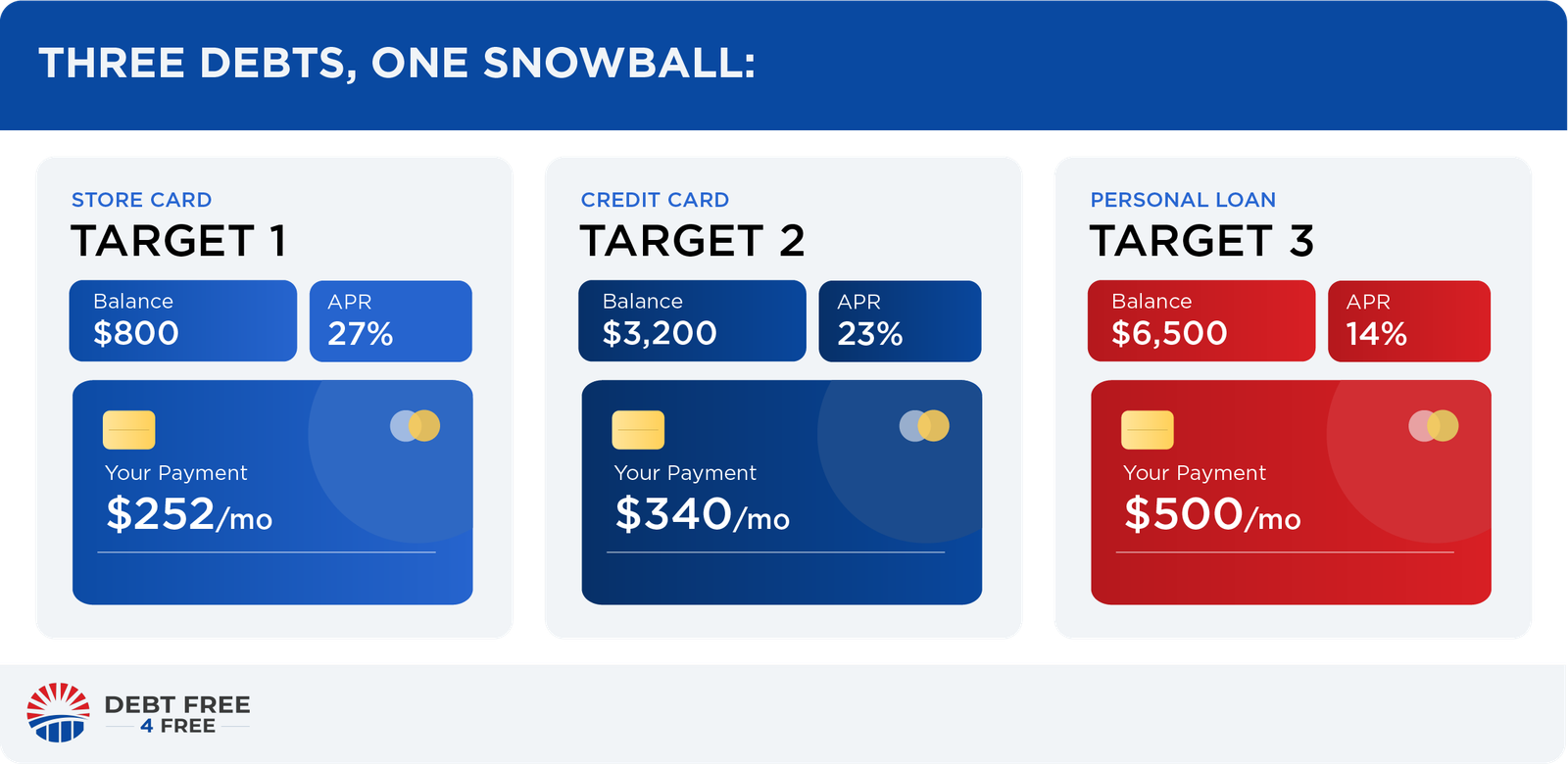
In this scenario, your minimums add up to $270 which leaves $230 left over for an extra payment each month. From here, the plan writes itself. You would continue to pay the $30 minimum on the store card as well as the $230 in extra payoff fuel which would clear the debt entirely in about three months. Once the debt is cleared, you could add the freed up $260 to the credit card's $80 minimum which means you'd have $340 a month to accelerate paying off the card. When you've cleared up the credit card debt, the entire $500 goes toward the personal loan. Notice how your total monthly payment never actually changes. Instead, the change is in how much of the payment goes toward a single debt, which rises as you close each account.
In the example we explored the smallest balance also happened to have the highest interest rate. This means that the snowball and avalanche methods would have started with the same debt. Overlap of these methods is common and shows you that the method of payoff often matters far less than simply having a plan and sticking to it.
Manage your debts with Credzy
Check out the Credzy app and sign up for the free plan to track your debt progress without the hassle of spreadsheets or complicated notes. Get started today and see your true debt free date in less than five minutes.
Start My Free Plan →Mistakes that derail a plan
A debt payoff plan, as you've been learning, is fairly simple to build. However, there are many common mistakes that you need to watch out for. The first is simply skipping out on a minimum payment for a debt that is not your current target as this can cause late fees and hurt your credit. Automate those minimums so it never happens by accident. The second is adding new debt while you pay off the old, which is like trying to bail out a boat without plugging the leak. For most people the single most important change is to stop using the cards they are paying down.
The third common mistake is setting the extra payment so high that when you run into an emergency or surprise expense it leaves you needing to take on more debt. Be sure to leave enough money left over that you can maintain a small emergency fund. The last common error you'll want to avoid is a simple one: forgetting to roll a freed-up payment toward the next debt once you've paid a balance off. Your whole plan works based on that rollover, so getting that transition right is a crucial step you don't want to miss.
If the numbers do not work
Sometimes you finish the plan and the honest answer is that there is no extra payment to be found, because the minimums alone already consume most of your income. That is important information, not a personal failure. A payoff plan can only accelerate progress when there is some money to accelerate it with. If your timeline stretches past five to seven years, or your minimums leave nothing behind, it may be time to read when to stop trying to pay off debt yourself and to weigh outside options in self-directed payoff vs. debt relief programs.
The bottom line
It only takes one thirty minute work session to build yourself a debt payoff plan tailored to your unique situation. Getting started is always the hardest step and with this guide, you have all the instructions you need to take that step. Get your statements ready and build your plan today. The first time you successfully pay an account down all the way to zero and its payment rolls over to payoff the next debt, you will feel the momentum starting to build.