

On This Page
When you first hear, "cash envelope system," it sounds like something your great grandmother did to manage her money 50 years ago, and while that isn't wrong, the advantage of this method holds true just as much today. In this system, you withdraw cash and split it into envelopes which are labeled for each category of your spending. Then, when an envelope is empty, you stop spending anything in that category until you restock the envelope on payday. There are no apps, alerts, or professional dashboards, but you do get a tangible, physical visualization of exactly where your money is going and how much you have left to spend.
The system is also one of the most effective, easily-accessible tools if your problem lies in your spending rather than your planning. The reason for this is that your brain treats physical money differently than numbers on a screen, and that physicality can be a superpower for managing your debt. In this guide, we get you up to speed on how the system works, how to get started, which categories to focus on, and whether the method is fit for you in the first place.
What the Cash Envelope System Is
The way the cash envelope system works is fairly simple. You begin by determining how much you will spend in a certain category before withdrawing that exact amount in cash and putting it in an envelope with the applicable category written on it. Then, later in the month when the cash in that envelope runs dry, you are finished spending in that category until your next paycheck. Keep in mind that this is not a budget, it is a system for executing a budget and the limits you set for your categories are the biggest factor in how well this method will work for you.
This system goes back decades and was popularized by figures like Dave Ramsey. It has also been trending up in popularity lately, seeing a renaissance under the label "cash stuffing" which is really describing the same system.
When paired with other actual budgeting frameworks, like some of the ones we've covered such as zero-based budgeting or the 50/30/20 rule, the cash envelope system is a massive aid in enforcing the budget and making sure you stick to it. The physical reminders of exactly where your money is going, and how much you have left to spend, give you the feedback you need to maintain the momentum of managing a new budget.
Why Physical Cash Still Works
The effect is behavioral, and it has a name. Researchers Drazen Prelec and George Loewenstein described what they called the pain of paying, meaning the discomfort we feel parting with money and the way different payment methods dial that discomfort up or down. Handing over four twenty dollar bills registers as a loss. Tapping a card for the same amount barely registers at all.
Cash also makes your limit physical. A debit card has no visible floor. You can check your balance, but you have to decide to check it, and very few people check it in the middle of a store. An envelope tells you what is left without you having to do anything. You can see it.
Third, and most usefully, the constraint enforces itself. Most budgeting failures are not planning failures. They are moment-of-decision failures, where you know the number and spend anyway. An empty envelope removes the decision. No willpower is required because there is no money.
For someone paying off debt, this matters for one specific reason. Overspending in variable categories is what quietly consumes the extra payment you assigned. You did not sit down and decide to skip the extra two hundred dollars at your credit card. It went to takeout and small purchases spread across four weeks, a few dollars at a time. Envelopes plug that leak.
The system is not effective because cash is old-fashioned. It is effective because spending cash feels like losing something, and because an empty envelope makes your limit impossible to ignore at the exact moment you are deciding.
Setting It Up in Six Steps
The whole setup takes one sitting, and most of the work is deciding which categories to include.
- Start from your budget. You need category amounts before envelopes mean anything. Envelopes enforce numbers, they do not generate them.
- Pick only the categories that leak. Look at the last two months and find where you consistently overspend. For most households that is groceries, dining out, entertainment, and personal spending. Three or four envelopes is plenty. Twelve is a system you will abandon by week three.
- Set each amount for one pay period, not the whole month. A month-long envelope can be empty by the tenth. A two week envelope caps the damage and gives you a reset twice as often.
- Withdraw the cash on payday and split it immediately. The gap between withdrawing and sorting is where money quietly disappears. Do it in the parking lot if that is what it takes.
- Spend only from the envelope, and put the change back. Loose bills and coins that end up in a pocket are the most common reason an envelope runs dry early for no apparent reason.
- Reconcile at the end of the period. Whatever is left is a decision, not a bonus. Roll it forward, or send it at your debt.
That last step is where this connects to payoff. Leftover envelope cash sent at your top balance is a small extra payment, and those accumulate faster than people expect. For where it should land, our guide on how to pay off debt on your own covers the ordering methods.
Send your leftover envelope cash somewhere useful
The free Credzy plan tracks every balance and shows which debt your leftover cash should hit first, plus the payoff date it buys you. No fees and no credit check.
Start My Free Plan →Which Categories to Use Envelopes For
The principle is narrow. Envelopes are for spending that is variable, discretionary, and happens in person. Everything else belongs on autopay.
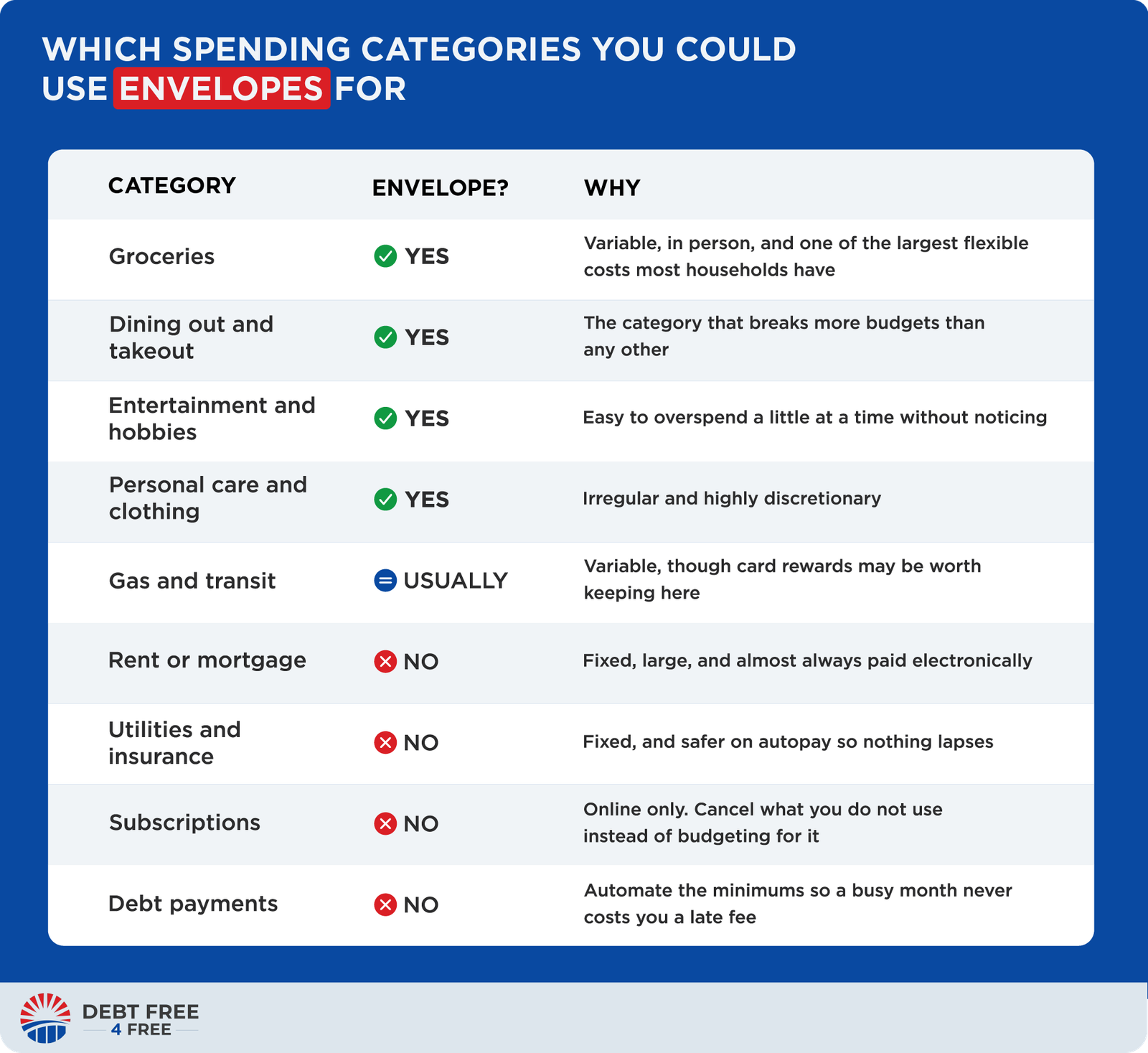
If you are unsure about a category, ask whether you have ever been surprised by how much you spent on it. Surprise means variable, and variable is exactly what envelopes are for.
The Digital Envelope Version
Plenty of people are not going to carry cash, and that is a reasonable position. The concept still transfers, with one real caveat.
Three approaches work. Budgeting apps built on the envelope concept let you assign money to virtual categories and watch them drain as you spend. Separate checking or savings sub-accounts do the same thing inside your actual bank, which some people find more concrete than an app. Per-category prepaid or debit cards enforce a hard limit at the register, closest to how cash behaves.
The caveat is that digital versions keep the categories and lose most of the friction. You still see the number, but you do not feel the payment, and your limit becomes a notification rather than an empty envelope. That is a meaningful downgrade in the specific mechanism that makes the system effective in the first place.
A practical middle path is to run cash on the two or three categories where you genuinely overspend and keep everything else digital. You get the friction where it matters without reorganizing your entire financial life around a trip to the ATM.
Drawbacks and Who Should Skip It
The system has real costs, and they are worth naming plainly rather than discovering later.
Cash has no fraud protection. If an envelope is lost or stolen, the money is simply gone. There is no chargeback and no dispute process, which is a good reason not to keep large amounts at home.
It also builds no credit history. If you are working on your credit alongside your debt, moving all of your spending to cash removes the on-time payment activity that helps. Keeping one card on autopay for a small recurring bill is the usual workaround.
It is awkward for online spending, which is a growing share of most budgets, and it requires a bank or ATM trip every pay period. That friction is the entire point at the register and a genuine annoyance everywhere else. Some people quit over the errand alone.
Skip the system if your overspending is not in variable categories, since envelopes will not touch a housing or car payment problem. Skip it if your income is highly irregular, because you may not know what to load until the money arrives. And skip it if you are already tracking digitally and hitting your numbers, because there is nothing here to fix.
Cash is not protected the way a card is. A lost envelope is a permanent loss with no recourse. Withdraw one pay period at a time, keep the envelopes somewhere consistent, and do not treat your home as storage for meaningful amounts of cash.
The Bottom Line
The cash envelope system is not a budget and it is not a payoff strategy. It is the layer that makes the categories you already set actually hold, which is why it pairs well with almost any framework you put underneath it.
If you want to test it without reorganizing anything, pick the single category where you overspend the most, withdraw that amount in cash for one pay period, and spend only from the envelope. One category, two weeks. That is enough to tell you whether the friction works on you.
For the budget underneath it, our guides on zero-based budgeting and the 50/30/20 rule cover the two frameworks most people build from.