

On This Page
If you are on your journey to becoming debt-free then it would seem like the advice to get yet another credit card is advice you should promptly ignore. And in most cases this is true, but secured credit cards are the exception as they have structural reasons that they can be practically useful, specifically the fact that the money which backs the card is your own money. In this setup, you are putting down a deposit and paying it on time each month.
That distinction is real, but it only holds if you use the card a particular way. Used wrong, a secured card is just a credit card with a high interest rate and a deposit attached. This guide covers how they actually work, who genuinely benefits, what to check before applying, and the handful of rules that keep it from quietly becoming another balance.
What a Secured Card Actually Is
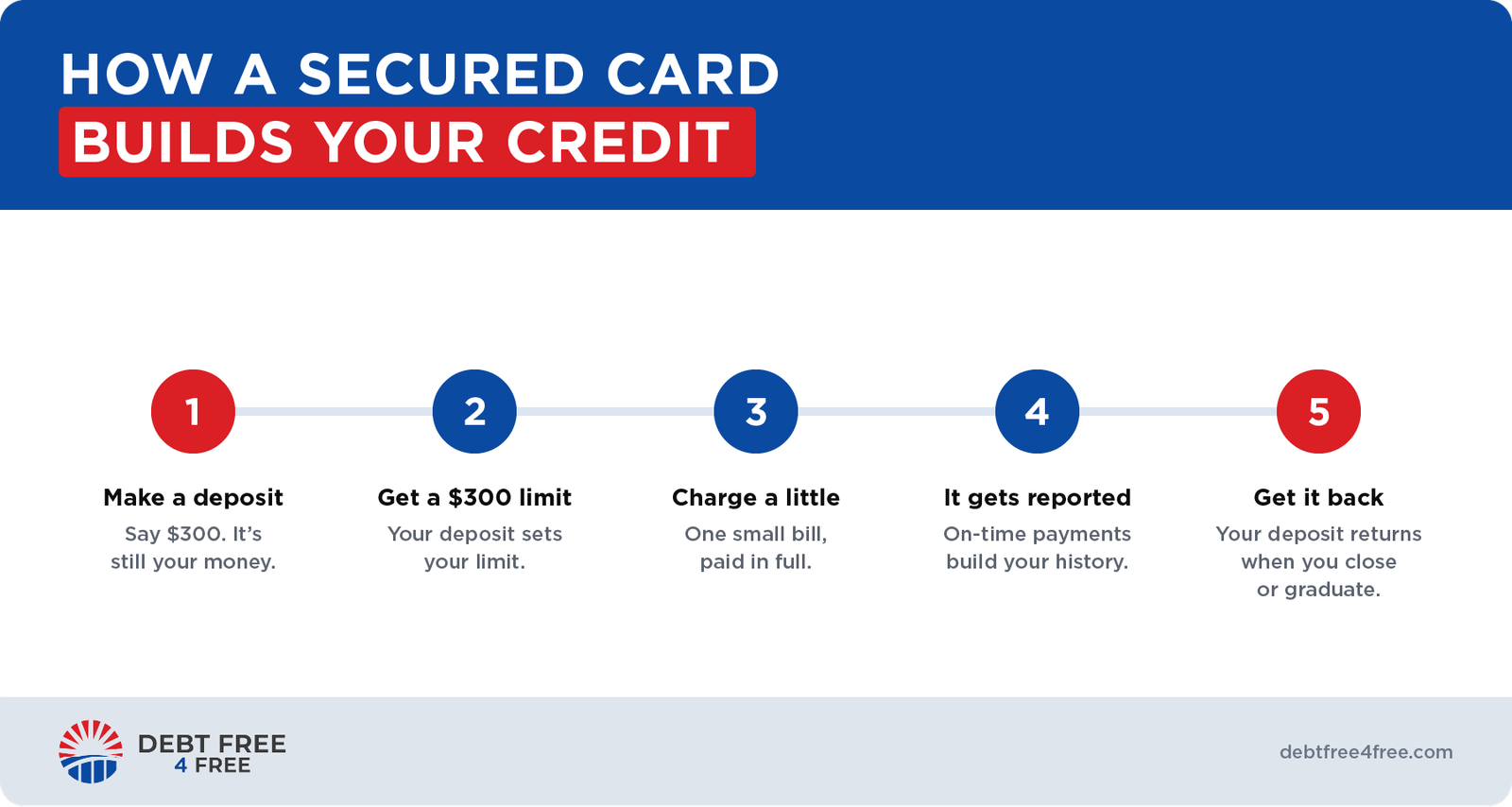
A secured card works like any other credit card from the outside. You get a card, you make purchases, you get a statement, and you pay it. The difference is what happens before any of that: you put down a refundable security deposit, and that deposit typically becomes your credit limit. Put down three hundred dollars, get a three hundred dollar limit.
The deposit is collateral for the issuer, which is why they will approve someone a regular card would decline. It is not a fee and it is not a payment toward your balance. It sits with the issuer, and you get it back when you close the account in good standing or when the issuer converts you to a regular unsecured card.
It is crucial to recognize here that the account will report to the credit bureaus the same way as any other card. That is the core value of this option and why it can be beneficial for someone who is trying to pay off debt. It's also important to point out that the deposit is not what will build your credit but rather the history of on-time payments that gets reported to the bureaus.
Why This Is Not the Same as Taking On More Debt
It should be obvious why some people object to this strategy, or at least are highly skeptical. You are on a mission to pay balances down, and yet here we are recommending that you open yet another line of credit. It is important to be precise about exactly why this can still be a good move. With a normal card, you are using money from the issuer of the card and paying a premium for the privilege of using said money. A secured card is different. Under a secured card, you pay the full statement every month and no money is borrowed past the grace period which means that no interest is charged. In this case, the deposit never moves and what actually changes is simply that a new tradeline comes into your file with a clean payment history, as long as you make the payments on time.
There is also a subtler benefit. A new account with a small limit adds to your total available credit, which can nudge your overall utilization down even while your other balances stay where they are. The effect is modest, and it is real.
None of this works if you carry a balance. That is not a caveat at the end, it is the whole condition.
The Catch: It Is Still a Credit Card
A secured card has the same mechanics as any other card, including the ones that cause trouble. The interest rates are typically high, often in the same range as the cards you are trying to pay off, and sometimes worse. If you carry a balance on it, you are paying that rate on your own spending while your deposit sits untouched with the issuer.
It also behaves the same way behaviorally. If your problem with credit cards has been reaching for one when money runs short, a secured card is the same temptation in a smaller size. The limit caps the damage, which is genuinely helpful, but it does not change the pattern. If you have just worked through stopping the credit card habit, think carefully about whether reintroducing a card is the right move this month or a problem for later.
The honest framing is that a secured card is a tool for building a payment record, not a tool for spending. If you cannot use it exclusively as the former, the credit building is not worth what it will cost you.
Who Should Actually Get One
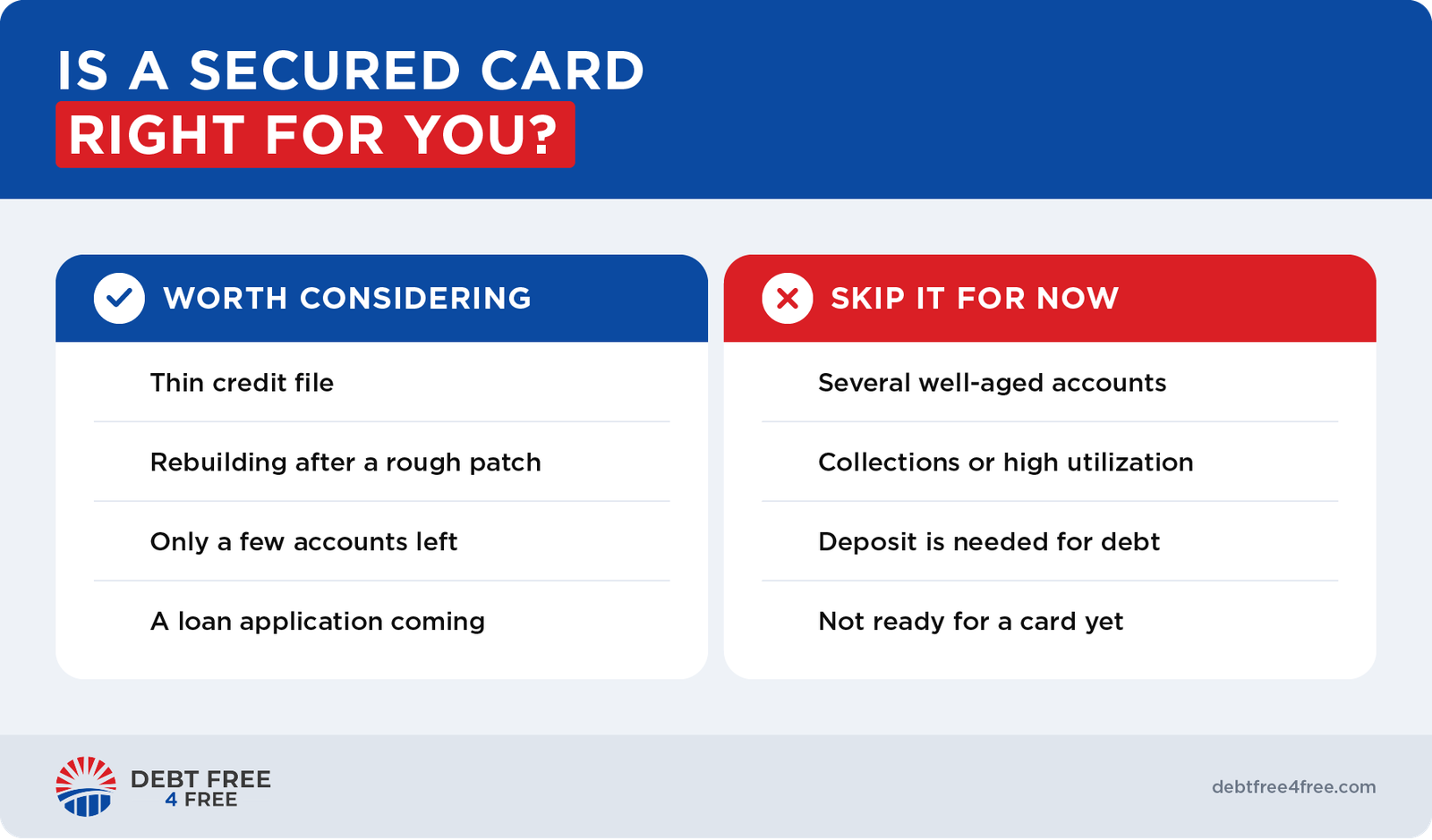
Secured cards are genuinely useful for a specific set of situations, and genuinely pointless for others.
What to Look For Before You Apply
Secured cards vary more than people expect, and a bad one can cost you money while delivering nothing.
It must report to all three bureaus. This is the single most important question and it is not universal. A card that reports to one bureau builds a record only the lenders checking that bureau will see. Confirm Experian, TransUnion, and Equifax before you deposit anything.
Watch the fees. Some secured cards carry annual fees, monthly maintenance fees, or application fees. A card with a meaningful annual fee is charging you for something plenty of competitors provide free. The deposit is not a fee, but fees stacked on top of it are a real cost.
Check whether the deposit earns anything. Some issuers hold it in an interest-bearing account. Most do not. It is not a dealbreaker either way, but it is worth knowing where several hundred dollars of yours is sitting.
Ask about the graduation path. The good outcome is that the issuer eventually converts you to a regular unsecured card and returns the deposit, keeping the same account and its accumulated history. Issuers that do this typically review after a set period of on-time payments. An issuer with no graduation path means closing the account to get your money back, which also ends the tradeline you spent a year building.
Reporting to all three bureaus, the full fee schedule, and whether the card can graduate to unsecured. Those three answers determine whether the card is worth the deposit. Get them before you apply, not after.
How to Use It So It Actually Builds Credit
The usage pattern matters more than which card you picked. Four rules cover almost all of it.
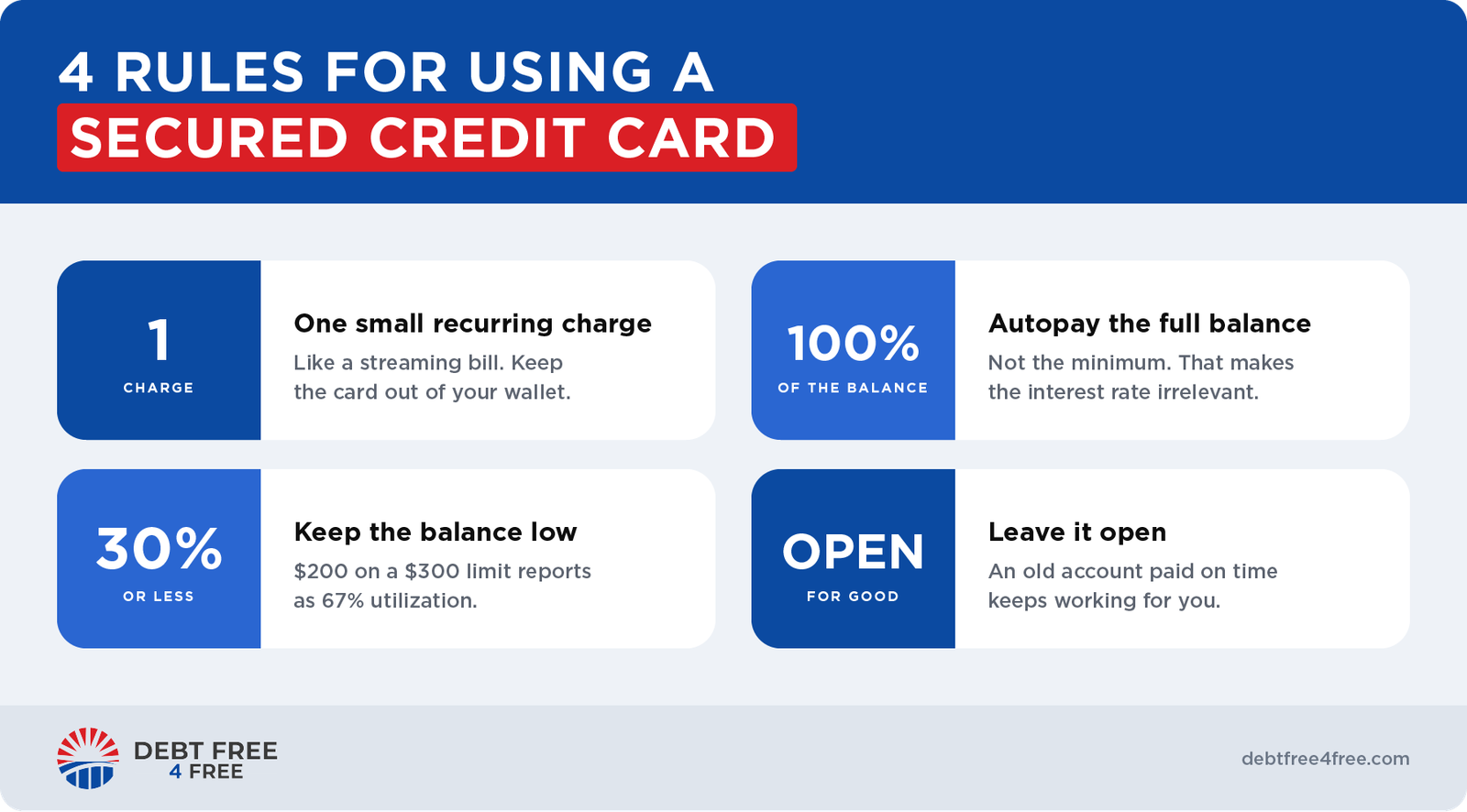
When you are carrying a balance on a secured card, you're getting the worst of both arrangements because you are paying a high interest rate on your own spending but also have hundreds of dollars sitting there as collateral. If you find yourself in a situation where the balance is not being fully cleared every month then the card is no longer working as a credit-building tool.
Build credit without losing the payoff plan
The free Credzy plan tracks every balance and your real debt-free date, so you can see whether a deposit is worth pausing for before you commit the cash. No fees and no credit check.
Start My Free Plan →Where the Deposit Comes From
This question is an important one, maybe even the most important when you are paying off debt, and yet most product comparisons skip it.
The money that goes toward a security deposit is money that you will not be able to put towards paying off your debt, which is particularly problematic when you have a balance which charges twenty percent or higher in interest.
The order we would suggest is straightforward. Cover your minimums. Fund a small starter emergency buffer, because without one a surprise expense lands back on a card and the whole plan reverses. Then, if there is still room, consider the deposit. Our guide on emergency fund versus debt works through that sequencing in detail.
What we would not suggest is funding the deposit out of the buffer, or out of money earmarked for a balance you are close to clearing. Credit building is a long game. The payoff is not.
Secured Card or Rent Reporting?
Both add a positive tradeline without new borrowing, so the natural question is which to do first.
| Secured card | Rent reporting | |
|---|---|---|
| Upfront cost | Refundable deposit, often $200 to $500 | Free to a monthly fee, depending on route |
| Ongoing cost | Possible annual fee, otherwise none if paid in full | None on a free tier, otherwise a subscription |
| Counted by | All scoring models, as a normal revolving account | Newer models only; older ones largely ignore it |
| Backdating history | No, it starts today | Sometimes, on paid tiers |
| Main risk | Becomes a balance if misused | Reporting lapses quietly, or late rent gets reported |
The practical answer is that rent reporting is the cheaper first move if your landlord already offers it, because it costs nothing and requires no deposit. A secured card is the stronger move if your file is thin, because a revolving account is counted by every scoring model rather than only the newer ones. Our guide on rent reporting to build credit covers that side in full.
Doing both is reasonable once the debt side is stable. Doing both before you have a buffer is not.
The Bottom Line
A secured card is one of the few ways to build credit that does not require borrowing, which makes it genuinely useful while you are paying down balances. The deposit is yours, the history is what counts, and the mechanics are simple enough to get right.
The rules that make it work are short. Report to all three bureaus. One small recurring charge. Autopay the full statement. Keep the reported balance under about a third of the limit. Leave it open.
Break the autopay rule and it stops being a credit-building tool and becomes an expensive small credit card. That is the only way this really goes wrong.
And keep it in proportion. If just the minimum payments on your debt balances are more than you can cover comfortably, a deposit is probably not the way that you should spend hundreds of dollars. If this is your situation, we recommend you check out our guide on when to stop trying to pay off debt yourself which covers how to tell when the debt side needs attention before anything else.